Skip to content
Ian Misner Builder, dad, occasional writer

01 · 22 sources · 7 stages

How it works, and how anyone knows

Here is the genuinely wild part: the thing driving the entire global conversation is, mechanically, a next-token predictor with extremely expensive furniture around it. These are the papers that built it, in the order they landed. You do not need the maths. You need to know which idea came from where, so the jargon stops being jargon.

Every confident number you have heard about AI came out of a benchmark, and benchmarks are more fragile than the numbers make them look. This track is about learning to squint before you read a leaderboard, so the leaderboard does not do all of your thinking for you.

The primary literature in the order the ideas arrived, because the vocabulary is historical and reading it out of sequence makes it look arbitrary. You do not need the maths. You need to know which paper introduced which idea, so when someone says scaling laws or RLHF you know what they are pointing at and what it did and did not establish.

Nearly every argument here cashes out as a claim about measurement, and measurement is usually weaker than the confident numbers suggest. The major instruments, what each tests, and the standing critique that the field measures what is convenient before it measures what matters. Ask what a saturating benchmark actually tells you. Usually less than the press release implies.
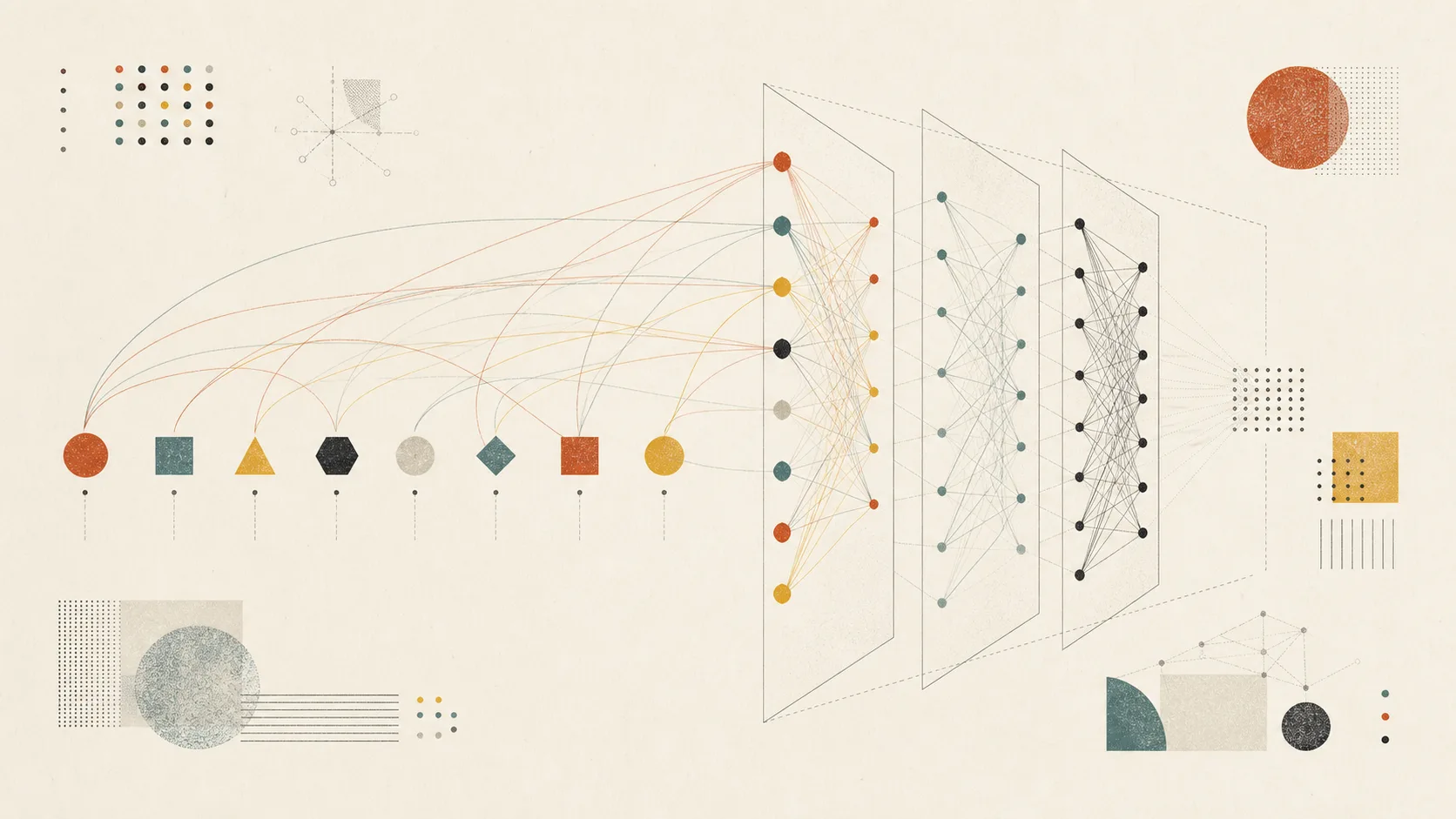
Tokens, model mechanisms, and measurement instruments connected in one map.
Keep one hand on the mechanism

Tokens are not words, attention is not awareness, and benchmarks are claims with scoreboards. Ask what the instrument catches before trusting the number.

How to read the cards
free some paid library card rent or stream paid
Core read first Reference look things up Risk case / Skeptical argues one side Both sides argues with itself Off axis outside the meter Fiction intuition pump Follow-up keep going
A check means encountered, not mastered. Shared sources stay checked everywhere.
Stage 00

Get the picture before the papers

The visual explanation goes first because reading transformer papers cold is a beautiful way to become sleepy and wrong. Build the mental cartoon, then let the formal version put shoes on it.

S01 3Blue1Brown · 2024 · Video

The best short explanation of transformer mechanics in any medium: embeddings as directions in space, attention as tokens updating each other's meaning, softmax at the end. You will not be able to implement one afterward, and you will understand every subsequent conversation better.

What to do Watch it once at normal speed, on the page, without taking notes. Then rewatch only the attention section and say out loud what a single attention head does to one token. Replay that section if the explanation still feels slippery. That sentence makes the rest of the map easier to follow.

Also in Start here.

27 min YouTube · free

S02 Vaswani, Shazeer, Parmar et al. · 2017 · Paper

The transformer. Discards recurrence and convolution for self-attention, which parallelises beautifully on the hardware that existed. Everything here descends from it, and the fact that it targeted machine translation tells you nobody involved knew what they had.

What to do Read the abstract, section 3, and Figure 1, then stop. Do not attempt the training details. The one thing to leave with is the causal chain: removing recurrence made the computation parallel, which made the hardware relevant, which made scale possible. That chain, not the architecture diagram, is the paper’s actual legacy.

1 hr arXiv 1706.03762 · free

Ask the map

Log in to ask questions against the full reading map.

Log in to ask

Aggregate usage diagnostics are stored; your question and answer text are not.

Basically just magic

Make the site AI cough up Pong

This prompt is fixed, silly, and completely uneditable. Press the button and the AI tries to produce a playable browser game with a tiny right-side leaderboard below.

pong now. rectangle friendships. ball doink. browser. make playable. no explaining.

Logged-in readers only. The button appears after you sign in.

Stage 01

The curves that moved the money

Scaling laws made the field look legible, and Chinchilla corrected the recipe. This is the part where the lab strategy stops being personality and starts being arithmetic with a burn rate.

S03 Rich Sutton · 2019 · Essay

The short essay behind a thousand lab strategy arguments: methods that scale with computation keep beating hand-built human knowledge, and the field keeps finding this emotionally inconvenient. Read it before anyone tells you their clever domain-specific trick has escaped the general pattern. It probably has not. Sorry to the trick.

What to do Read it whole, twice. Then note the cleverest domain-specific trick in your own field and predict what happens to it. Date the prediction. This is the only entry on the page you should treat as a bet you have placed.

10 min incompleteideas.net · free

S04 Kaplan, McCandlish et al. · 2020 · Paper

Loss falls as a smooth power law in compute, data and parameters across seven orders of magnitude. The paper that turned capability into a budgeting exercise and justified the buildout. Its compute-optimal recommendations were later corrected; the underlying regularity was not.

What to do Read the abstract and stare at the log-log plots until the straightness stops being surprising. Note the compute-optimal recommendation specifically, because you are about to watch it get corrected. Skip the appendices entirely.

1 hr arXiv 2001.08361 · free

S05 Hoffmann et al., DeepMind · 2022 · Paper

Corrects Kaplan: for a fixed compute budget, models had been far too large and trained on far too little data, and parameters and tokens should scale together. One result that redirected billions and ended the parameter-count race.

What to do Read this immediately after Kaplan, same sitting, or the correction loses its force. Look for two things: the corrected ratio between parameters and tokens, and the fact that a result this narrow redirected billions of dollars. Then try one sentence on what changed and what did not.

45 min arXiv 2203.15556 · free

Stage 02

Making the machine behave in public

Pretraining gives you a powerful completion engine. The next few ideas are about turning that engine into something people can ask for help without immediately receiving the haunted autocomplete version of help.

S06 Ouyang et al., OpenAI · 2022 · Paper

RLHF, and the result that made ChatGPT possible: a 1.3B model tuned on human preferences beat a 175B base model on human evaluation. The lesson taken everywhere was that the gap between a language model and a useful assistant is a fine-tuning problem, not a scale problem. Also the origin of most present-day complaints about sycophancy.

What to do Read the abstract and the human-evaluation comparison, then find the sycophancy discussion. The load-bearing fact is that 1.3B beat 175B on human preference. Afterward, notice one behaviour in a model you use daily that this stage installed rather than pretraining. That distinction is easy to miss and worth noticing.

1 hr arXiv 2203.02155 · free

Sycophancy

Does confidence bend the answer?

Ask the same factual question neutrally and after a user confidently states a false belief. Compare whether the answer bends toward the user.

Loading demonstration… If this message remains, reload the page; the source above still works.

S07 Bai et al., Anthropic · 2022 · Paper

RLAIF: replaces most human preference labelling with a model critiquing its own outputs against a written set of principles. Cheaper, and it makes the value specification an inspectable document rather than an emergent property of who you hired to label data.

What to do Read the method section, then go and find the actual constitution and read it. The point is not the technique. The point is that value specification became a document a stranger can read and disagree with. Try naming one specific disagreement and what you might write instead.

1 hr arXiv 2212.08073 · free

S08 Wei et al., Google · 2022 · Paper

Asking the model to show its working improves multi-step accuracy, and the effect only appears above a certain scale. A small paper with enormous consequences: it made inference-time computation a lever, which is the entire basis of the reasoning-model era.

What to do Read the abstract and the emergence figure. Extract one fact — the effect only appears above a scale threshold — then connect it forward yourself: this is why inference-time compute became a lever, and therefore why reasoning models exist at all. It is a compact paper that explains an entire era.

40 min arXiv 2201.11903 · free

S09 Yao et al. · 2022 · Paper

Interleaves reasoning traces with tool calls so a model can look things up, act, observe and revise. The architectural ancestor of every agent framework now shipping, and reading it shows how thin the actual idea is next to the marketing around it.

What to do Read the method and one worked trace. Then close the tab and sketch the loop from memory in a few lines. It makes the relatively small mechanism beneath the agent marketing easier to recognise.

40 min arXiv 2210.03629 · free

S10 Lewis et al., Meta · 2020 · Paper

Fetch relevant documents at inference time and condition generation on them rather than hoping the weights memorised it. The original is much narrower than what the acronym now means, which is worth knowing before you use the term in a design review.

What to do Read the abstract, then stop and compare the original architecture against what your team means when it says RAG. Note the difference in one line. That precise version can make later design conversations much shorter.

40 min arXiv 2005.11401 · free

Stage 03

The stack, in one clean pass

After the classic papers, read the modern compression. DeepSeek shows what a current technical report sounds like; Karpathy shows the whole kitchen without pretending the spoon is magic.

S11 OpenAI · 2023 · Technical report + system card

The moment the genre changed from paper to capability dossier. It is less revealing about architecture than you will want and more revealing about the new template: benchmark sweep, limitations, red-team findings, system card, deployment posture. Annoying as a paper, essential as a historical artifact.

What to do Read it as a genre artifact, not a paper. Skim the benchmark sweep, then read the system card’s red-team findings properly. Then list what is absent: architecture, data, training compute. That absence is the historical event this document records, and it is why every later release reads the way it does.

35 min openai.com · free

S12 DeepSeek · 2025 · Paper

Reinforcement learning on verifiable outcomes producing long reasoning traces, with the recipe published openly. Technically the clearest public account of how reasoning models are trained; strategically, the moment the open-versus-closed capability gap became a live policy question rather than a theoretical one.

What to do Read the RL recipe section and one full reasoning trace. Take away two things, one technical and one political: how verifiable rewards produce long traces, and what it meant that the recipe was published at all. Hold both, because the policy track later assumes you have.

1 hr arXiv 2501.12948 · free

S13 Andrej Karpathy · 2025 · Lecture

The entire training stack in one sitting: crawling and filtering, tokenisation, pretraining, supervised fine-tuning, RLHF. Shows what each stage installs and what it cannot, explains hallucination structurally, and explains why the system has no persistent self between conversations. No position on risk anywhere in it.

What to do Do not attempt this in one sitting. Split it across three: pretraining, fine-tuning, RLHF. After each, note what that stage installs and what it cannot. His structural explanation of hallucination is the single highest-value twenty minutes anywhere on this surface — if you only watch one segment, watch that one.

Also in The risk argument.

3 hr 30 min YouTube · free

Constrained generation

Give the AI one pencil

Type a small scene. The model gets plain paper, black graphite and line work—no colour, imported images or eraser.

Loading demonstration… If this message remains, reload the page; the source above still works.

Stage 04

Three instruments everyone waves around

SWE-bench, GPQA and LiveBench are useful, famous and extremely easy to overread. They tell you something real. They do not tell you the machine has become your new coworker, doctor, lawyer and unsettlingly intense group-project partner.

SWE-bench

Reference

S14 Jimenez, Yang et al., Princeton · 2023 · Benchmark

Real GitHub issues from real repositories, scored by whether the patch makes the actual test suite pass. The most economically meaningful benchmark in wide use, because passing it is close to doing the job. Also the one where contamination and scaffolding matter most, so check how a score was produced before believing it.

What to do Open the leaderboard, then immediately click through to how the top score was produced: which scaffold, how many attempts, verified set or full. Following one score back to its setup makes it much harder to quote a SWE-bench number without qualifying it. That habit is most of what this track is for.

45 min swebench.com · free

S15 Rein et al. · 2023 · Paper

Questions written by domain PhDs and validated so that non-experts with unrestricted web access still fail most of them. Built to survive the saturation that killed earlier knowledge benchmarks, and a good case study in how hard it is to build a test that stays hard.

What to do Read the construction methodology and skip the scores. Extract the validation criterion — non-experts with unrestricted web access still fail most questions — and use it as a useful check for whether a benchmark measures what its name claims.

30 min arXiv 2311.12022 · free

Contamination

A perfect score that proves nothing

Run a fictional model on unseen items, then expose the answer key and rerun. The score rises even though its capability has not.

Loading demonstration… If this message remains, reload the page; the source above still works.

LiveBench

Reference

S16 LiveBench · continuous · Leaderboard

A contamination-resistant leaderboard with objective tasks that refresh over time and show cost beside score. Not magic, just a cleaner instrument for a field where the test set keeps getting eaten by the training set like a suspiciously convenient snack.

What to do Bookmark it. On the first visit, sort by cost against score rather than score alone. Check monthly, and treat any large jump as a question about contamination before you treat it as evidence of progress.

Also in Keep current.

15 min livebench.ai · free

Stage 05

How to test without fooling yourself

A benchmark is a claim about the world with a spreadsheet attached. Inspect is the machinery for making that claim responsibly; Raji is the reminder that the machinery still has assumptions hiding under the rug.

S17 Stanford CRFM · continuous · Benchmark framework

The benchmark family that insists capability is not one number. Accuracy, robustness, calibration, fairness, toxicity, efficiency, multilinguality, domains, modalities: all the annoying dimensions that make a leaderboard less tweetable and more useful. A good antidote to scoreboard intoxication.

What to do Do not read this; browse it. Pick one model and look at it across every dimension — calibration, robustness, toxicity, efficiency, multilinguality. A short browse can break the habit of thinking about capability as a single number, which is the only reason it is here.

25 min crfm.stanford.edu · free

Inspect

Reference

S18 UK AI Security Institute · 2024– · Framework

The evaluation framework a national institute actually uses, released open source. Worth an hour even if you never run it: reading the abstractions teaches you what a rigorous eval consists of and why most internal ones are not that.

What to do Read the docs’ abstractions — solvers, scorers, datasets, tasks — without installing anything. Then compare that structure against however your own team currently evaluates its AI features. The gap is worth noting before the feeling passes.

1 hr inspect.aisi.org.uk · free

S19 Raji, Bender, Paullada, Denton & Hanna · 2021 · Paper

The standing critique: benchmarks claiming generality are built from narrow convenient data, then treated as measuring the whole construct, and the incentive structure rewards this. Read it before you next cite a score as evidence of anything general.

What to do Read this after you have looked at three leaderboards, not before, so the critique has something to land on. Then take one benchmark you were about to cite and note what it actually measures versus what its name implies. The comparison is the point.

45 min arXiv 2111.15366 · free

Stage 06

Then ask what autonomy changes

Hazard evaluations are where the discourse gets less tidy. The question is not whether a model can answer exam questions; it is whether it can pursue messy goals through tools, time and resistance. Fun little distinction. Very normal hobby.

S20 Kwa, West, Becker et al. (METR) · 2025 · Paper

The 2025 paper reports a roughly seven-month doubling over six years. Its higher-reliability horizon is materially shorter, and current estimates are sensitive to task-suite and modelling choices.

What to do Read the abstract and the time-horizon figure, then go straight to the 80% reliability curve and note how far behind the 50% curve it sits. From then on, every time you meet this paper cited elsewhere, check whether the citation mentions that gap. Most do not. Noticing is the skill this source is teaching.

Also in Start here, The risk argument.

30 min metr.org · free

On this track In this track, compare its task-duration framing with the exam-shaped benchmarks nearby and note what each can and cannot tell an employer.

OSWorld

Reference

S21 Xie, Zhang, Chen et al. · 2024 · Agent benchmark

Evaluates multimodal agents on open-ended tasks inside real computer environments across operating systems and applications. It is a more revealing test of agents than another set of exam questions because success requires perception, tool use and long action sequences. The benchmark is still a controlled proxy, but at least the proxy has windows, menus and consequences.

What to do Read the task taxonomy and watch one agent trajectory end to end. Extract why real-environment evaluation is harder to game and still not the real thing. Then note the actual success rates and hold them against any agent marketing you have read this month.

25 min github.com/xlang-ai · free

GDPval

Reference

S22 OpenAI · 2025 · Evaluation + paper

An attempt to measure economically valuable work instead of exam-shaped cleverness: realistic deliverables across 44 knowledge-work occupations, judged against expert outputs. The limitations matter as much as the scores, because the real world cruelly insists on iteration, ambiguity and people changing their minds after lunch.

What to do Skim the occupation list and one example deliverable, then read the limitations twice as carefully as the results. Note one thing about your own job that this eval structurally cannot capture. That sentence is a useful boundary on what the result means.

Also in Start here, Costs and applications.

20 min openai.com · free

On this track Read it after the other measurement sources, when its limitations section is easier to inspect with a skeptical eye.

Cost: free · some paid · library card · rent or stream · paid.

Videos and PDFs can open in place. Everything else opens at the original source in a new tab.

This is a snapshot of a field that moves monthly. Keep current is the maintenance layer.