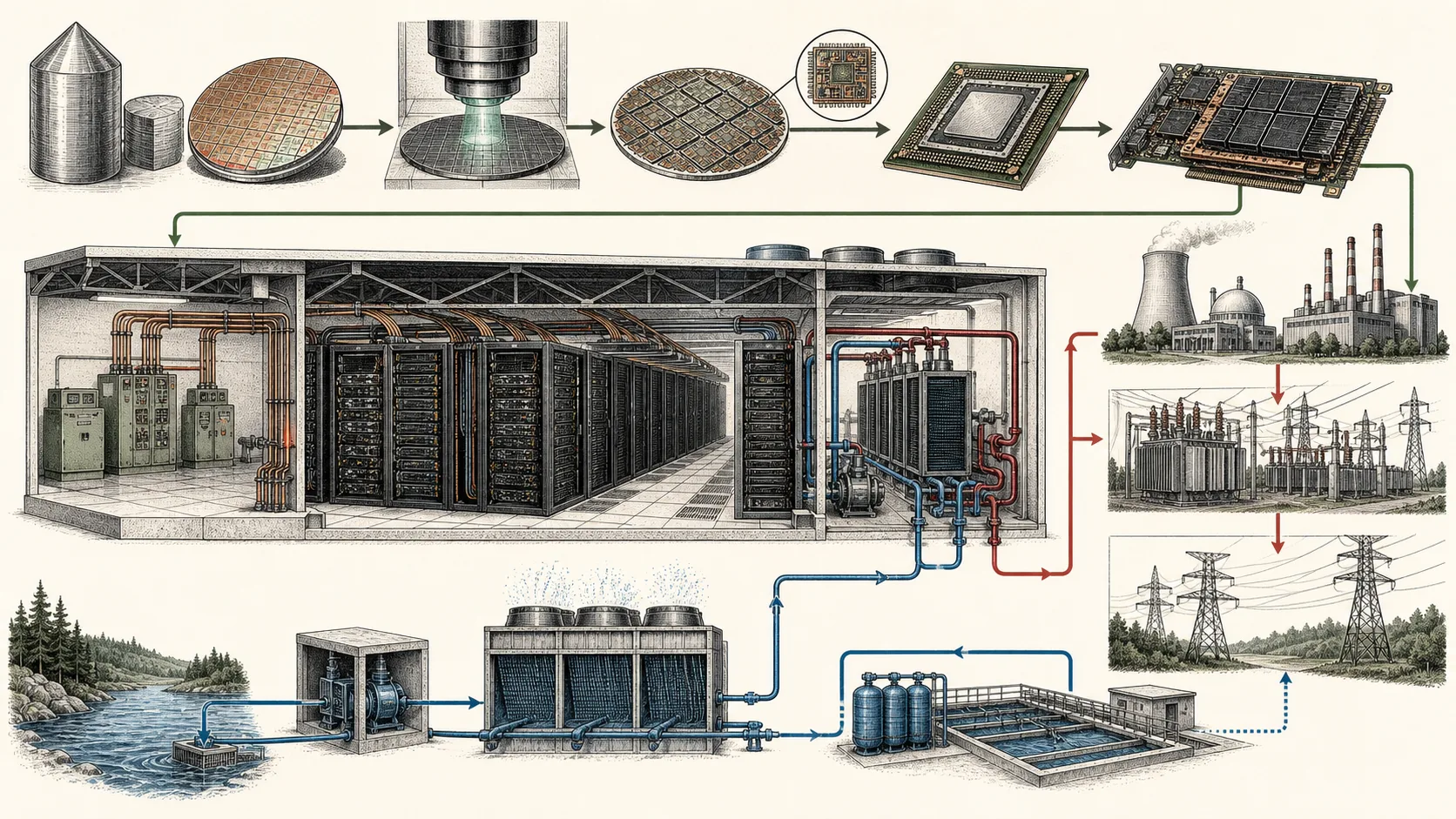
Somebody is spending hundreds of billions of dollars on enormous buildings full of hot sand, and whether that arithmetic works is arguably the entire ballgame. It is also the part of this argument with real public accounting attached to it. This track is the one most likely to move your timelines, in either direction.
Share a checkpointCopy a grid, image card, or short progress reflection.
The capability debate happens almost entirely without the numbers that will determine the outcome: what inference costs, what a data centre costs, where the power comes from, and whether the revenue exists. This is the track most likely to change your mind about timelines, in either direction, because the constraints are physical and the accounting is public.
00
Follow the compute
The model may feel ethereal. The bill is not. Start with the curves and the chip accounting, because many beautiful theories of the future die quietly in a procurement spreadsheet.
Training compute, hardware price-performance, algorithmic efficiency, inference cost and data supply, as live charts. Two facts do most of the work elsewhere: frontier compute has grown several-fold annually for a decade, and the cost of any given capability falls fast once it exists.
Also in Start here. Ticking it here marks it there.
02
Dylan Patel et al. · continuous · Industry analysis
The reference on chips, fabs, interconnect, data centre buildout and the actual supply chain. Technical, sometimes paywalled, and where the industry reads to find out what the industry is doing.
Aggregate usage diagnostics are stored; your question and answer text are not.
01
Then find the wall socket
Data centres are not abstract. They need power, water, land, permits and neighbours who become suddenly passionate about substations. Infrastructure is where timelines learn to stand in line.
The authoritative treatment of data centre electricity demand, grid implications and regional concentration, from the body that does this for every other energy question. Replaces both the alarmist and the dismissive version of the energy argument with scenarios.
04
Lawrence Berkeley National Laboratory · 2024 · Report
The US-specific accounting beneath the data-centre energy argument: historical electricity use, facility characteristics and scenario ranges through 2028. Pair it with the IEA's global outlook. One gives you the worldwide system; this gives you a detailed national inventory with assumptions visible enough to argue with.
The cloud has a factory floor, a wall socket and a water bill.
02
Finally, ask whether the value shows up
Revenue, productivity and welfare are different nouns doing different jobs. This is where the argument stops being can we build it and becomes who benefits, how much, and whether the receipt matches the sermon.
05
Brynjolfsson, Li & Raymond · 2023 · Field study
Five thousand customer support agents given an LLM assistant. Productivity rose about 14% on average, concentrated almost entirely among the least experienced workers, with little effect on the most skilled. The most-cited empirical result on AI and labour, and the distributional finding is the part that keeps getting dropped.
NBER working paper; the abstract page links the PDF and ungated versions circulate.
A standard task-based growth model applied honestly: roughly 5% of tasks profitably automatable within a decade, producing around 1% of total factor productivity growth in total. Adds that the most susceptible tasks are often ones where errors are hard to detect, so measured gains may overstate real ones. If a Nobel laureate is approximately right, most forecasting elsewhere is off by an order of magnitude.
NBER working paper 32487, later published in Economic Policy.
Anthropic's running attempt to measure how people actually use Claude at work and what that implies for tasks, wages and the economy. It is company data, so keep your skepticism plugged in, but it is still unusually direct evidence about usage rather than vibes wearing a necktie.
Also in Applications. Ticking it here marks it there.
08
Chatterji, Cunningham, Deming et al. · 2025 · NBER working paper
A large privacy-preserving study of consumer ChatGPT use, including work versus non-work use, topic mix, adoption patterns and the surprising amount of value created through advice, information and writing rather than pure programming. Consumer usage is not the economy, but it is a real window, and windows beat fog.
Also in Applications. Ticking it here marks it there.
09
International Labour Organization · 2025 · Working paper
Maps generative-AI exposure across occupations and countries using a task-level index refined with worker input. Its central finding is more transformation than outright replacement, with exposure distributed unevenly by occupation, income level and gender. Useful ballast against both the no-jobs and no-change versions of the labour story.
An attempt to measure economically valuable work instead of exam-shaped cleverness: realistic deliverables across 44 knowledge-work occupations, judged against expert outputs. The limitations matter as much as the scores, because the real world cruelly insists on iteration, ambiguity and people changing their minds after lunch.
The field's annual census: capability, investment, adoption, cost, policy and public opinion, all sourced. Skim the top takeaways on release, then use it year-round as the reference whenever someone quotes a number at you. The adoption-versus-measured-value gap in the economy chapter is the most interesting figure in it and the one most often skipped.
After the accounting, let one friendly impossible version in. Banks imagines the bill paid, abundance real and machine governance mostly benevolent, then asks the awkward human question: what are people for when the systems are better at almost everything?
The Culture is post-scarcity, run by benevolent superintelligent Minds, and Banks's decision was to make it work. Then he asks what is strange about that: humans deeply loved, materially perfect, entirely unnecessary. The fictional companion to Deep Utopia and considerably more fun.
Second Culture novel, reads standalone. Start here rather than Consider Phlebas.